
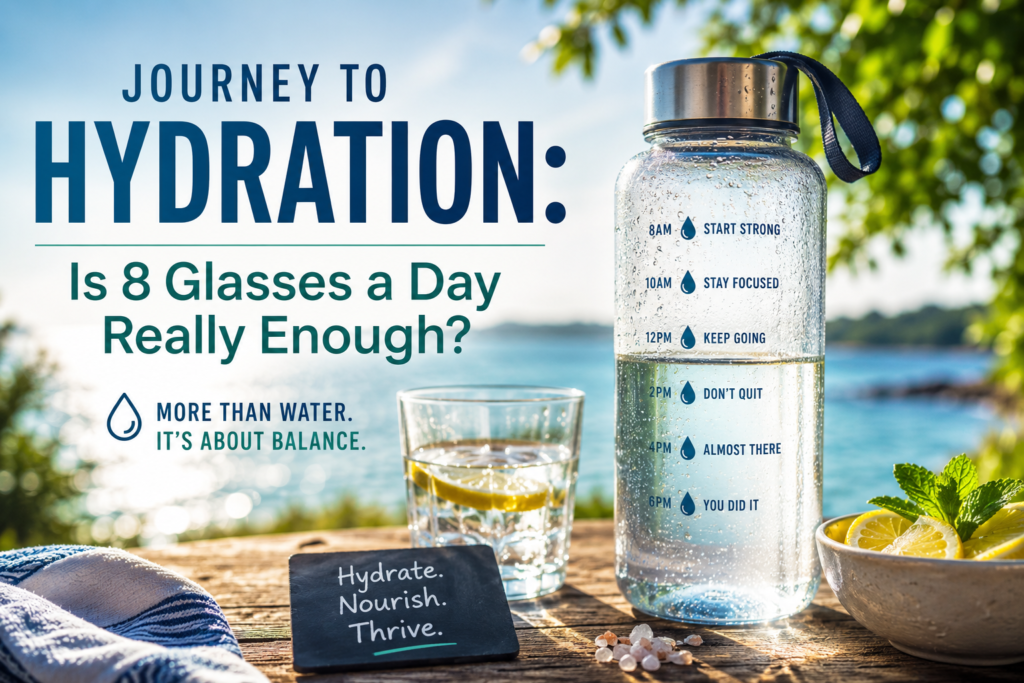
July has a way of turning our attention toward water.
The temperatures climb. We spend more time outdoors. We mow lawns, take vacations, go to the lake, fire up the grill, and enjoy longer days in the sun.
And somewhere along the way, most of us hear the same familiar advice:
“Make sure you drink your eight glasses of water a day.”
It sounds simple enough.
But like many things in health and wellness, hydration is more nuanced than that.
The truth is that our hydration needs are influenced by far more than an arbitrary number. Activity level, body size, climate, sweat rate, nutrition, medications, and even our age can all dramatically affect how much fluid our bodies actually require.
In other words:
Hydration is personal.
And perhaps even more surprising, drinking more water is not always the same thing as being better hydrated.
Insights
1. Hydration Is More Than Water
Most people think hydration simply means drinking enough water.
But proper hydration also depends on maintaining the right balance of electrolytes like sodium, potassium, magnesium, and chloride.
These minerals help regulate fluid balance, muscle contractions, nerve function, and blood pressure.
Without adequate electrolytes, water cannot always get where your body needs it most.
Hydration is not just about quantity.
It is also about balance.
2. The “8 Glasses a Day” Rule Is More Guideline Than Science
The famous recommendation to drink eight 8-ounce glasses of water each day has been repeated for decades.
The reality is that there is surprisingly little scientific evidence supporting this exact number for every person.
Some people may need considerably more.
Others may need less.
Factors such as exercise, heat exposure, humidity, caffeine intake, medications, and dietary choices can all influence hydration needs.
Your body is remarkably intelligent.
For many healthy individuals, thirst remains one of the best guides.
3. Clear Urine Doesn’t Always Mean Optimal Hydration
Many people have heard that perfectly clear urine is the goal.
In reality, consistently crystal-clear urine may sometimes indicate overhydration.
Pale yellow urine is often considered a better indicator of adequate hydration for most healthy adults.
Like many aspects of health, more is not always better.
Balance matters.
4. Mild Dehydration Can Affect More Than Physical Performance
Even mild dehydration can influence energy, concentration, mood, and cognitive performance.
Research has shown that fluid losses as small as 1-2% of body weight can begin affecting both physical and mental performance.
Sometimes that afternoon fatigue or headache may not require more caffeine.
It may require more water.
Final Takeaway
Hydration is one of the simplest and most powerful tools we have to support health, yet it is often overlooked until we feel thirsty.
This summer, instead of focusing on an arbitrary number, consider paying closer attention to your body’s signals.
Drink consistently throughout the day.
Replace fluids lost through sweat and activity.
Include electrolytes when appropriate.
And remember that hydration isn’t simply about drinking more.
It’s about giving your body what it needs to function at its best.
Progress, Not Perfection.
1% at a Time.
This month’s 1% Upgrade is simple:
Before reaching for your second cup of coffee, afternoon energy drink, or evening snack, pause and ask yourself one question:
“Am I hungry… or am I thirsty?”
You may be surprised how often your body is asking for hydration rather than calories.
Small adjustments repeated consistently often create the biggest improvements over time.
Because sometimes feeling better starts with something as simple as a glass of water.
All journeys start with a single step.
Evidence-Informed Note
This article reflects current understanding from exercise physiology, hydration science, and sports nutrition research related to fluid balance, electrolyte regulation, and human performance.
Selected References
Popkin BM, D’Anci KE, Rosenberg IH. (2010). Water, Hydration, and Health. Nutrition Reviews.
Sawka MN, Cheuvront SN, Carter R. (2005). Human Water Needs. Nutrition Reviews.
Armstrong LE et al. (2012). Mild Dehydration Affects Mood in Healthy Young Women. Journal of Nutrition.
National Academies of Sciences, Engineering, and Medicine. (2005). Dietary Reference Intakes for Water, Potassium, Sodium, Chloride, and Sulfate.
Share via: